


Abstract / Executive Summary
Schedule and cost overruns are endemic to complex, multi-task operations across aerospace, energy, healthcare, finance, and infrastructure. In 2002, NASA’s Kennedy Space Center (KSC) and Lumina Decision Systems, Inc. addressed this problem on an unusual scale, collaborating under a Phase II Small Business Innovation Research (SBIR) contract to build the Schedule and Cost Risk Analysis Modeling (SCRAM) system.
Deployed against the full complexity of Space Shuttle ground processing (approximately 1,000 major tasks across 24 subsystems per mission cycle), SCRAM combined probabilistic task modeling, visual influence diagrams, and Monte Carlo simulation into a system that NASA formally assessed as a significant improvement to the state of the art in schedule and cost risk analysis. This article documents that collaboration, examines the SCRAM methodology in detail, and makes the case that its underlying approach transfers directly to any domain defined by stochastic scheduling, cost uncertainty, or multi-stage risk interaction.
Introduction
Every large project carries a version of the same problem. A project manager builds a schedule, maps the dependencies, and sets a completion date that looks achievable on paper. Then reality intervenes: an inspection fails, or a key component arrives late. One delay feeds into the next, and the timeline keeps moving on its own.
Gantt charts and deterministic critical-path analysis assume that task durations are known quantities, close enough to fixed that treating them as constants introduces acceptable error.
For simple projects in stable environments, this holds.
For complex, multi-stage operations with hundreds of interdependent tasks and meaningful exposure to rare but consequential events, it breaks down.
Task durations follow probability distributions. Dependencies are often conditional. A rare event in one subsystem can cascade across an entire operation in ways deterministic models will never surface. This applies equally to energy infrastructure, pharmaceutical development, large-scale construction, and any domain where complexity and uncertainty meet.
Probabilistic methods address this gap directly. Monte Carlo simulation, influence diagrams, and related techniques treat uncertainty as a structural feature of the model rather than noise to be averaged away. The practical barrier has historically been accessibility: these methods required specialist tools and statistical expertise that most organizations could not sustain internally.
What NASA needed at Kennedy Space Center in the late 1990s was a system that made probabilistic modeling both realistic and interpretable. That requirement, it turns out, is not specific to launching space shuttles.
The Space Shuttle Turnaround Challenge

The Space Shuttle program was built on an economic premise: that a reusable launch vehicle would reduce the cost of access to space compared to expendable rockets. Each orbiter would fly, return, be refurbished, and fly again, spreading development and manufacturing costs across a large number of missions. In practice, the refurbishment process between missions proved far more expensive and time-consuming than originally projected, with turnaround cycles stretching into months and costs that approached those of the expendable systems the Shuttle was meant to replace [1].
The operational burden fell on the Kennedy Space Center, which was responsible for all ground processing between landing and the next launch. This encompassed testing and checkout of three major hardware elements: the orbiter itself, the external tank, and the solid rocket boosters. Each turnaround cycle involved approximately 1,000 major processing tasks distributed across 24 subsystems.
The task structure was not uniform. Roughly half of those 1,000 tasks were required on every turnaround cycle, regardless of circumstances. The remainder varied: some recurred on a periodic maintenance schedule, others were mission-specific, and some were triggered by problems discovered during inspection or testing. This conditional, heterogeneous task structure meant that no two turnaround cycles were identical, and that the total scope of work for any given cycle could not be known with certainty in advance.
Managing schedule and cost risk across an operation of this complexity required tools capable of representing that uncertainty. KSC’s existing tools could not. As NASA documented in Spinoff 2002, they “provided constrained and limited modeling capabilities” and were unable to produce realistic models of how task durations and conditional occurrences would interact across a full processing cycle [1]. SCRAM was designed to close that gap.
The Collaboration Between NASA KSC and Lumina


The project was funded through a Phase II Small Business Innovation Research (SBIR) contract. The SBIR program is a federal initiative that directs research and development funding toward small businesses, with the explicit goal of moving technology from government-funded research into commercial application. Phase II awards follow a successful Phase I feasibility study and typically fund the full development of a working system. For NASA, SBIR contracts have served as a primary mechanism for engaging specialized commercial expertise on problems that fall outside the agency’s internal capabilities.
The contract brought together NASA’s Kennedy Space Center and Lumina Decision Systems, Inc. Lumina’s flagship product, Analytica, had been recognized by MacWorld magazine’s Charles Seiter as the best single decision-analysis program yet produced, and it was selected for this project on the basis of two capabilities that proved directly relevant to the problem at hand.
The first was visual model structuring through influence diagrams, a graphical representation of variables and their dependencies that allows domain experts to review and validate model logic without requiring programming knowledge. In a project of this scope, the ability for NASA engineers and operations staff to inspect and challenge the model directly was a precondition for building something that accurately reflected operational reality.
The second was probabilistic analysis as a core feature rather than an add-on. Analytica was designed from the ground up to represent uncertain quantities as probability distributions and to propagate that uncertainty through a model using Monte Carlo simulation.
The deliverable that emerged from the collaboration was the Schedule and Cost Risk Analysis Modeling (SCRAM) system, built on Analytica as its computational engine and deployed at Kennedy Space Center to support ground processing risk management [1][2].
Methodology: How SCRAM Works
SCRAM is based on three pillars: probabilistic task modeling, visual influence diagrams, and the Monte Carlo simulation.
Probabilistic Task Modeling
The foundation of SCRAM is the treatment of task duration and costs as uncertain quantities rather than fixed value. Each of the approximately 1,000 processing tasks in a Shuttle turnaround cycle was assigned a probability distribution describing the range of time it might require, reflecting the reality that some tasks finish quickly and others take longer than expected, depending on conditions that cannot be known in advance.
Beyond duration, the model addressed conditional occurrence. Many tasks in a ground processing cycle are not guaranteed to run at all. A rework task, for instance, only becomes necessary if a preceding inspection reveals a defect.
In SCRAM, these contingent tasks were represented as probabilistic branches: the model could express both the likelihood that a given task would be required and the distribution of its duration if triggered. Cost uncertainty was modeled in parallel with schedule uncertainty throughout, allowing SCRAM to produce joint estimates of how time and expenditure would interact across a full processing cycle [1].
Visual Influence Diagrams
The scale of the model created an immediate practical problem: a system representing 1,000 tasks across 24 subsystems, with conditional dependencies running in multiple directions, cannot be usefully documented in a spreadsheet. Spreadsheet-based models of this complexity are effectively unauditable. A change in one cell can propagate through dozens of dependent calculations in ways that are difficult to trace, and domain experts without programming backgrounds have no reliable way to verify that the model reflects operational reality.
Analytica’s influence diagrams addressed this directly. The model was structured as a visual network in which nodes represented variables (task durations, occurrence probabilities, costs, and resource constraints) and the connections between them represented conditional relationships. This structure allowed NASA engineers and operations staff to inspect the model’s logic, trace dependencies, and identify misrepresentations without needing to read code or parse formula chains. Collaborative model-building and validation between analysts and domain experts became possible in a way that a spreadsheet implementation would not have supported [1][2].
Monte Carlo Simulation
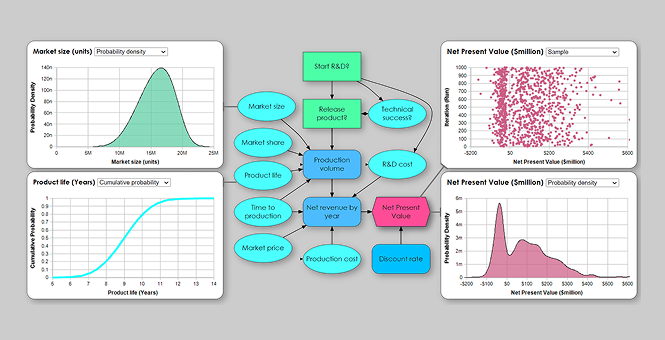
With the model structure in place, SCRAM used the Monte Carlo simulation to generate results. Monte Carlo simulation is a computational method that samples repeatedly from the specified probability distributions to generate the full distribution of possible outcomes, rather than a single expected value. In practice, SCRAM ran thousands of such trials, each drawing task durations and conditional outcomes from their respective distributions and computing the resulting turnaround time and cost for that simulated scenario.
Aggregating across those trials produced probability distributions over total schedule and total cost, giving NASA planners a quantified picture of the range of outcomes they might face and the likelihood of each. Sensitivity analysis then identified which tasks and subsystems were contributing most to overall variance, pointing directly to the areas where risk reduction efforts would have the greatest effect [1].
Outcomes and NASA’s Assessment
SCRAM was successfully implemented at Kennedy Space Center and, according to NASA’s own account, improved the risk management processes supporting Shuttle ground operations [1]. The agency’s formal assessment went further than noting successful deployment, however.
NASA documented that SCRAM represented as follows:
“A significant improvement to the state-of-the-art in schedule and cost risk analysis” because it allowed “realistic models of schedule variables, such as task lengths” to be built and analyzed in ways that prior tools could not support [1].
— Kennedy Space Center
The previous generation of risk analysis tools was structurally incapable of representing the stochastic reality of a ground processing cycle. They could not model task durations as distributions, could not handle conditional occurrence, and could not propagate uncertainty through a system of interdependent tasks at an operational scale. SCRAM did not simply do the same thing faster; it did something the existing tools could not do at all.
NASA did not publish quantified before-and-after metrics in the Spinoff 2002 record, and none are claimed here. The documented outcome is the agency’s institutional recognition of a methodological advance, formalized in a publication NASA uses specifically to highlight technologies it considers significant contributions to the state of the art [1].
From SCRAM to ADE: Commercialization Pathway
The SCRAM project produced more than a risk management system for the Kennedy Space Center. During the course of the work, Lumina developed a deployable version of Analytica called the Analytica Decision Engine (ADE). The NASA Spinoff 2002 record refers to this product as the Analytica Design Engine; Lumina’s current product documentation uses the name Analytica Decision Engine. The two names most likely reflect the same product at different points in its naming history, though readers consulting both sources should be aware of the discrepancy [1][2].
Where the standard Analytica platform is designed for analysts building and running models interactively, ADE was engineered to be embedded within larger software systems, functioning in practice as a decision-analytics engine that other applications could call upon. This made it possible to incorporate Analytica’s probabilistic modeling capabilities into products built for end users who would never interact with the modeling environment directly.
ADE was adopted across a range of downstream applications, several of which are documented in the NASA Spinoff 2002 record and are examined in the following section. The pattern itself is exactly what the SBIR program is structured to produce: federally funded research generating a capability that moves into the commercial sector and finds application well beyond its original context [1].
Transferable Applications Across Industries
The SCRAM methodology is not aerospace-specific. Any domain in which outcomes depend on many probabilistically-linked tasks or events, task durations or costs are uncertain, and decision-makers need to identify the largest sources of risk will benefit from the same approach. The structural properties that made SCRAM effective at Kennedy Space Center (a large number of interdependent tasks, conditional occurrence, and cost uncertainty running in parallel with schedule uncertainty) are present in a wide range of industries.
Several of the applications below are documented in the NASA Spinoff 2002 record; others represent structural extensions of the same methodology to domains that Analytica currently serves.
| Industry | Structural parallel to SCRAM | Applied use cases |
|---|---|---|
| Energy & power | Stochastic generation schedules, uncertain demand, and regulatory timing | Capacity planning under uncertainty; outage scheduling; cost-effectiveness analysis of pollution-control technologies for fossil-fuel power plants (cited example from NASA Spinoff 2002) |
| Environment & climate | Long-horizon uncertainty, rare events, policy-dependent pathways | Resources for the Future used ADE to facilitate a U.S. Department of Energy assessment of the 1990 Clean Air Act Amendments (documented in NASA Spinoff 2002); integrated climate assessment modeling |
| Health & pharmaceuticals | Uncertain trial outcomes, resource demand, portfolio trade-offs | Forecasting needs for hospital beds and healthcare resources (cited example); selecting a portfolio of R&D projects to maximize return and balance risk for pharmaceutical companies (cited example) |
| Business & finance | Multi-stage investment decisions, stochastic returns, and conditional branches | Project and portfolio risk analysis; capital allocation under uncertainty; insurance and reinsurance modeling (earthquake insurance optimization is an existing Analytica case) |
| Transportation & manufacturing | Multi-task production cycles, maintenance scheduling, supply-chain risk | Fleet maintenance scheduling; production line risk analysis; supply-chain scenario modeling — structurally identical to Shuttle turnaround |
| Aerospace & defense | Complex programs, milestone risk, contractor dependency | R&D project portfolio selection for aerospace companies (cited example); program risk analysis for major platforms; NASA’s own continued use context |
| Consumer technology | Decision support surfaces, personalization with uncertainty | Ask Jeeves used the Analytica Decision Engine to build the Jeeves Purchase Advisor — an early example of consumer-facing decision analysis (documented in NASA Spinoff 2002) |
| Management consulting | Client decision problems with high stakes and incomplete information | Decision Strategies, Inc. used ADE to develop interactive flow-chart models and reportedly saved a single client $15 million (documented in NASA Spinoff 2002) |
Energy and Power
The energy sector presents scheduling and cost problems that are structurally close to Shuttle ground processing. Generation capacity planning requires modeling demand distributions, regulatory approval timelines, and equipment availability simultaneously, and the NASA Spinoff 2002 record documents a specific early application in cost-effectiveness analysis of pollution-control technologies for fossil-fuel power plants [1].
Outage scheduling presents an analogous challenge, with maintenance windows, grid demand, and failure probabilities interacting in ways that deterministic planning tools handle poorly.
Health and Pharmaceuticals
In healthcare and pharmaceutical development, uncertainty is not an edge case but a central feature of the decision environment. The NASA Spinoff 2002 record documents ADE applications in both hospital resource forecasting and pharmaceutical R&D portfolio selection, where the objective was to allocate investment across a pipeline of projects with uncertain returns and correlated risks [1].
The portfolio selection problem is structurally similar to SCRAM’s sensitivity analysis function: identify which projects contribute most to overall outcome variance, and act on that information.
Business and Finance
Capital allocation decisions in business and finance share the multi-stage, conditional structure that SCRAM was built to handle, and an investment portfolio with uncertain returns and time-dependent cash flows is formally the same kind of problem as a processing cycle with probabilistic task durations and conditional branches.
Analytica has been applied to insurance and reinsurance modeling, including earthquake insurance optimization, where low-probability, high-consequence events interact with portfolio-level exposure in ways that require probabilistic propagation rather than point estimation. Project risk analysis and capital budgeting under uncertainty extend the same logic to broader corporate finance contexts.
Remaining Industries
Transportation and manufacturing operations involving multi-task production cycles or fleet maintenance scheduling are structurally analogous to Shuttle turnaround, with variable task durations, conditional dependencies, and compounding cost implications across a full cycle. Management consulting and consumer technology applications are documented in the NASA Spinoff 2002 record directly: Decision Strategies, Inc. applied ADE to interactive client decision models and reported saving a single client $15 million [1], while Ask Jeeves used ADE to build the Jeeves Purchase Advisor, an early instance of probabilistic decision support deployed at consumer scale [1].
Why the Methodology Generalizes
SCRAM’s core methodology contains nothing specific to aerospace. Its underlying primitives apply to any operational context where outcomes depend on uncertain, interdependent events and decision-makers need to locate the largest sources of risk. Three properties explain why the approach travels well across industries:
- Domain-neutral primitives. Stochastic task durations, conditional occurrences, cost uncertainty, and visual influence diagrams are descriptions of a general class of problem, not an aerospace-specific one. Any organization whose decisions depend on probabilistic task or event networks is working with the same structural material.
- Scale generality. The NASA deployment involved approximately 1,000 tasks across 24 subsystems, an unusually demanding test of the approach. Most organizations face analogous problems at smaller scale. A methodology that performs at Kennedy Space Center’s level of complexity will handle a pharmaceutical R&D portfolio or an energy capacity plan without difficulty.
- Auditability. Visual influence diagrams allow model logic to be inspected and challenged by people who did not build the model. This matters as much for a pharmaceutical portfolio review or a regulatory cost-effectiveness submission as it does for Shuttle ground processing. Spreadsheet models at comparable scale cannot offer the same assurance.
The commercialization record bears this out empirically. Within a few years of the NASA project, ADE had been deployed in consumer technology, environmental policy, management consulting, and healthcare forecasting. These domains have little else in common beyond the structural properties SCRAM was built to address. Applying this methodology successfully depends on problem formulation, rather than the software itself.
Conclusion
The SCRAM project demonstrates what rigorous probabilistic risk analysis looks like at an operational scale. Faced with approximately 1,000 interdependent processing tasks across 24 subsystems, NASA Kennedy Space Center and Lumina Decision Systems built a system that could represent that complexity honestly, and NASA formally assessed the result as a significant improvement to the state of the art in schedule and cost risk analysis [1].
The Shuttle-specific implementation is not what transfers. What transfers is the underlying approach: treat uncertain quantities as distributions, model conditional relationships explicitly, propagate uncertainty through the full system, and structure the model so that its logic can be inspected by the people who understand the operation. Those principles apply wherever complex, interdependent tasks interact with uncertain outcomes and real cost consequences.
Analytica was the platform on which SCRAM was built, and it remains the platform on which the same class of problem is addressed across energy, healthcare, finance, environmental policy, and beyond.
References
[1] NASA. (2002). Quick fix for managing risks. In Spinoff 2002 (pp. 122–123). U.S. Government Printing Office. ISBN 0-16-067542-1. NTRS Document ID 20020080107. https://ntrs.nasa.gov/citations/20020080107
[2] Lumina Decision Systems. (n.d.). NASA Space Shuttle mission: Reducing time and costs [Case study]. Analytica. https://analytica.com/case-studies/reducing-time-and-cost-for-nasa-space-shuttle-mission/
[3] U.S. Small Business Administration. (n.d.). Small Business Innovation Research (SBIR) program. https://www.sbir.gov