
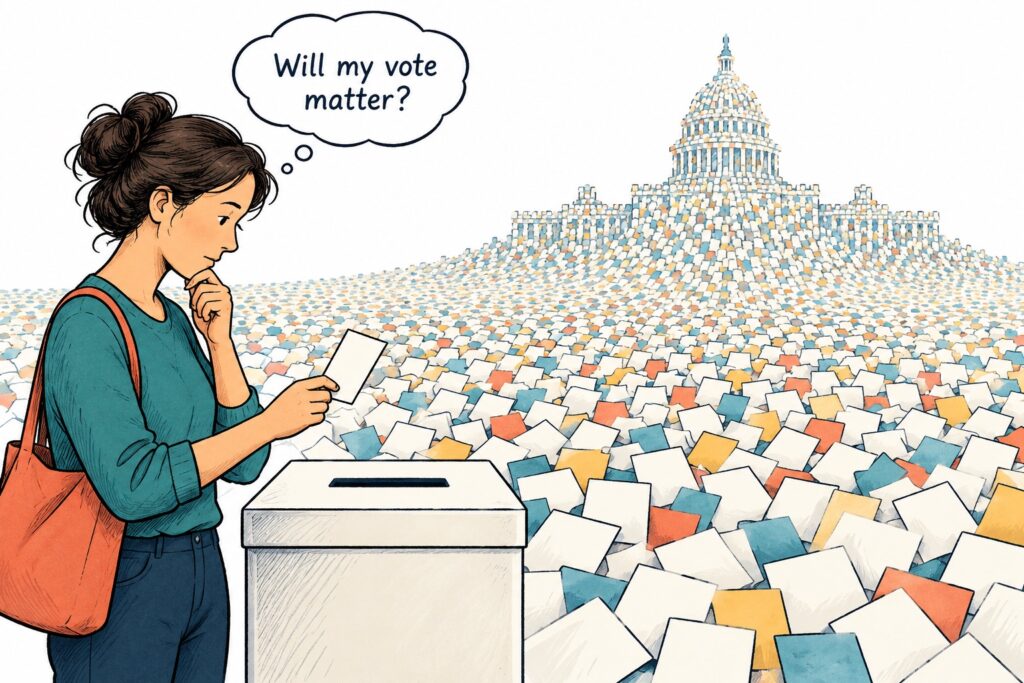
Many voters view the upcoming midterm elections as highly consequential—maybe determining the future of democracy in the USA. Even if you’re one of them—you might still wonder: will my vote make any difference?
A tied election: In 2024, my longtime friend and colleague, Lonnie Chrisman, voted in an election in which two candidates tied for second place with 30,249 votes each. This was a Primary Election for California’s 16th Congressional District in San Jose, where only the first two candidates would advance to the General Election (KTVU News, Apr 3, 2024). But after a recount, one candidate, Evan Low, ended up with 5 more votes and advanced to the General Election.
There have been roughly 20,000 elections for national office (the House, Senate, and President+VP) since 2000, including primaries and general elections. But I could find no other case that resulted in a difference of one vote or less. (There were a handful of State or local elections ending in a tie, sometimes resolved by a coin toss or drawing lots.) If we treated the 2024 San Jose primary as a tie, we would have a rough upper bound of 1/20,000 probability of a vote difference of one or zero per election.
Whose vote? In the Presidential Election of 2000, the final outcome depended on Florida, where George HW Bush initially received 537 more votes than Al Gore. That excluded about 200,000 ballots that were ruled invalid as undervotes, where voting machines detected no Presidential vote (the infamous “hanging chads”) or overvotes, where they detected more than one vote. Florida’s Supreme Court ruled that the 60,000 ballots with undervotes should be recounted.
By December 12th, 2000, the “safe harbor” deadline, the recount was incomplete, and the US Supreme Court ruled that a constitutionally acceptable recount could not be completed in time. This made George Bush the President by dint of having won the vote prior to the recount. Since the Supreme Court ruled 5 to 4, you could say that the final result was determined by a single vote.
The voting paradox: But, if you don’t happen to be a Supreme Court Justice, the chance that your individual vote changes the result is vanishingly small. You could spend hours studying the candidates and casting your ballot. Wouldn’t your time be better spent doing something more worth your time? If you multiply the benefit of your preferred candidate winning by the minimal probability that your vote changes the outcome, the expected value is almost certainly less than the cost of voting. This question is called the voting paradox, first addressed by Anthony Downs in An Economic Theory of Democracy (1957).
Before you decide to stay home, let’s think about what this calculation leaves out.
Count the benefits to everyone: When you estimate the benefit of a better representative, and possibly better government, whose welfare counts? Just yours? Or also that of your family, neighbors, all fellow citizens, or even future generations?
A tiny chance of changing an outcome affecting millions can have substantial expected value. A 1/20,000 chance of $1 billion of net social benefit to society yields $50,000 of expected benefit. You might reasonably give others’ welfare less weight than your own, but you needn’t count it zero.
This doesn’t establish that it’s worth voting in every election. You still need to consider how close the contest is, what you consider the value of your preferred candidate, and the cost to participate. But you can make a straightforward expected-utility case for voting without assuming selfishness. That was the argument of Aaron Edlin, Andrew Gelman, and Noah Kaplan in “Voting as a Rational Choice” (2007).
Reciprocity: You benefit from a functioning democracy whether or not you help sustain it. That makes it tempting to abstain: let everyone else do the work. Yet everyone else may make the same calculation.
We face a collective-action problem: Our individual choices can undermine something we value as a society. “What if nobody votes?” identifies the danger, but doesn’t quite answer “Why should I vote when others will?” You need an additional principle—perhaps reciprocity or contributing your fair share. The basic analysis of this free-rider problem is Mancur Olson’s The Logic of Collective Action (1965).
Civic satisfaction: You may regard voting as a responsibility that comes with citizenship. If so, fulfilling that responsibility has value to you even if your ballot doesn’t change the winner. It may make you feel nice and warm inside.
Your decision calculation should reflect that warmth. Of course, this raises a further question: why accept the duty in the first place? Civic satisfaction explains how voting can fit your preferences; it doesn’t establish that everyone ought to have those preferences. William Riker and Peter Ordeshook incorporated these benefits into A Theory of the Calculus of Voting (1968).
Express what you stand for: You probably do things because they express something you care about, without necessarily expecting them to change the world. You might cheer for your team, attend a memorial, wear a cause’s emblem, or go on a march.
Voting can serve a similar purpose. Your ballot expresses your political commitments and solidarity with others who share them. If that expression matters to you, its value belongs in your decision. Geoffrey Brennan and Loren Lomasky developed this account in Democracy and Decision (1993).
Don’t be a “rational fool”: We act from commitments as well as personal advantage. You might keep a promise, accept an inconvenient responsibility, or contribute fairly even when you would personally benefit from doing otherwise in a single case. Must you get enough satisfaction to compensate for every such sacrifice before it becomes rational? Or can you have good reasons to uphold a principle despite the personal cost?
That question challenges the assumptions behind the voting paradox. Amartya Sen’s article, “Rational Fools”, argues that an account of choice centered on personal welfare leaves out the essential role for public commitment (1977).

The broader questions
Individual decision theory helps you weigh consequences, uncertainty, and costs—including consequences for other people. Game theory shows how your incentives interact with everyone else’s, and why shared benefits may still fail to secure participation. Ethics asks which commitments and responsibilities deserve a place in your deliberation.
So when you decide whether to vote, ask more than “Could my ballot break a tie?” Ask whose welfare you count, what participation means to you, what civic responsibilities you accept, and what you stand for. You don’t have to believe your vote will decide the election to think it’s worth casting.
A final observation: Maybe it’s not such a bad thing that individuals who focus only on their own narrow interests are less likely to vote than people who value community and commitment.