
In episode 3 of Supermodeling and AI, Lonnie Chrisman takes a walk down “probability street” to answer a question that sounds like it has a dull textbook answer: what exactly is a probability? Starting from Bruno de Finetti’s provocative claim that “probability does not exist,” he moves from Pascal’s gambling table to the trillionth digit of π, an AI lab, Kahneman’s unfinished textbook, the fog around AGI forecasts, and finally your own office spreadsheet. Along the way you make two bets of your own, and at the end you find out how well you did.
Key takeaways
- Frequency is what you count; probability is what you believe, given what you know. Probability doesn’t need randomness, and people with different information can reasonably hold different numbers.
- “I have no data” is rarely a good reason not to estimate. Take the outside view: find a reference class and start from its base rate.
- Before you put a number on something, sharpen the question until a clairvoyant could settle it (the clarity test).
- One number in a spreadsheet cell hides uncertainty without removing it, and the flaw of averages can make plans late on average.
- Never say 0 or 100 (Cromwell’s rule), and keep score. Calibration is a skill, and it can be learned.
Chapters
- 0:00 Introduction: “probability does not exist”
- 1:30 Born at a gambling table: frequency vs. probability
- 3:02 Probability without randomness: the trillionth digit of π
- 6:49 One launch, three probabilities
- 8:30 No data? Kahneman and the outside view
- 11:09 AGI, the fog, and the clarity test
- 13:44 Your office and the flaw of averages
- 16:25 Lost on the way up: the Bay of Pigs
- 17:49 Keeping score: calibration and Cromwell’s rule
- 21:00 How did you do on your bets?
- 22:56 Superforecasters: it’s a skill
- 24:58 Wrap-up: probability lives in you
Full transcript
Introduction: “probability does not exist”
Welcome to another episode of Supermodeling and AI, where we’ll be discussing topics in decision intelligence, modeling, and AI. I’m your host, Lonnie Chrisman, and today we’ll ask: what exactly is a probability?
In 1974, a major work by the Italian mathematician Bruno de Finetti began coming out in English: a big, serious, two-volume Theory of Probability. Hundreds of pages and equations, the works. And in the preface, in capital letters, he wrote: Probability does not exist. Which is a bold way to open a book about probability. Imagine a cookbook that opens with “Food does not exist.”
Here’s the thing: I think he was right. There are other ways to interpret probability, and I’ll name the main rival in a minute. But this episode takes de Finetti’s side. And by the end of this episode, I hope you’ll be putting probabilities on things more often, not less.
We’re going to take a walk. It starts where probability feels right at home, and it ends somewhere you might not expect: your own desk. Along the way, I’ll ask you to make a couple of bets. So grab something to write with, or if you’re driving, just hold the numbers in your head. We’ll check how you did before we’re done. This is Supermodeling and AI. I’m Lonnie. Let’s go.
Born at a gambling table: frequency vs. probability
Probability, as a branch of mathematics, was born at a gambling table in Paris, 1654. A gambler, the Chevalier de Méré, brings Blaise Pascal a puzzle that gamblers had been arguing about for over a century and a half. Two players are in the middle of a game, the game gets interrupted: how should they fairly split the pot?
Gambler: We were winning, Pascal! Well… I was winning.
Pascal writes to Pierre de Fermat about it, and in the letters that follow, the mathematics of probability takes shape. At the gambling table, probability feels solid. What are the chances of rolling a six? Roll the die ten thousand times and count. You’ll land close to one in six. That count has a name: a frequency.
And here I want to plant a flag. One influential school of thought says that’s what probability is: just long-run frequency in repeatable trials. I’m going to use two different words instead. Frequency is what you count. Probability is what you believe, given what you know. At the gambling table, the two line up beautifully. The count is the best evidence you could ask for. But most questions that matter in your life never come with ten thousand rolls. So let’s walk out the door.
Probability without randomness: the trillionth digit of π
Skeptic: Hold on. You can’t put a number on things that aren’t dice!
That’s our skeptic. He’s going to follow us. Right outside the door is his first test.
The number π: 3.14159, and its digits go on forever without repeating. Computers have now worked it out to hundreds of trillions of digits. So here’s my question. What’s the probability that the trillionth digit of π, counting after the decimal point, is a 7?
Notice what’s odd about this. There’s nothing random here. That digit was fixed before any of us was born. It is what it is, and you could look it up. But you haven’t. So pause and write down a probability estimate as a number between 0 and 1.
OK. If you wrote 0.1, or ten percent, or 1 in 10, nicely done. Ten possible digits, no reason to favor any of them, so ten percent is a very reasonable answer. If you wrote “it’s either a 7 or it isn’t, so fifty-fifty,” I’d gently point out that you’d say the same about 3, and 4, and 9, and now your probabilities add up to five hundred percent.
Skeptic: …Hmph! OK. Here’s a harder one. I’m going to read you a short passage. Your job: what’s the probability it was written by an AI?
Here’s the passage: The 19-year-old singer was caught on camera being escorted out of the store by security guards. The singer was wearing a black hoodie with the label ‘Blurred Lines’ on the front and ‘Fashion Police’ on the back.
So, write down your probability.
Now, one clue. This passage was published in 2019.
Did your probability move after you learned that? For many people it drops, because a passage published in 2019 was far less likely to be AI-written than one published today. If your probability went down, that’s exactly right. You learned something, and your probability changed.
Here’s what I want you to notice. The passage didn’t change. Nothing out in the world moved. What changed is what you know. Now, I’ve looked up both answers, so for me right now these probabilities are very close to zero or a hundred percent. Not exactly, though. I got them from a web page and a computer program, so either has a chance of being wrong. Call it 99.99 percent. For you, they’re somewhere in between. Different information justifies different probabilities.
Hold on to both of your probabilities. We’ll see how you did at the end of our walk. So on the view we’re taking, probability doesn’t need randomness. It just needs you not to know.
Skeptic: Fine. But π is a math puzzle. Real life isn’t like that. Real things only happen once!
Fair point. Let’s walk a few blocks, to an AI lab.
One launch, three probabilities
A new AI model is supposed to ship next Tuesday. Let’s ask three people how likely that is.
First, someone who reads the tech news. News reader: They announced it, so… but these things always slip. Ummm. Sixty percent?
Second, an engineer on the team. Engineer: Two of the safety evals are still failing. Honestly? Thirty percent.
Third, the CEO. CEO: Launch partners are locked in. I’ve seen the plan. Eighty-five percent.
Sixty, thirty, eighty-five percent. So which one is the probability that it ships Tuesday? The answer is: all of them. Nobody knows what will happen on Tuesday. Each of them is giving their best summary of what they know, and they know different things. That doesn’t mean anything goes. If the engineer said 85%, he’d be ignoring what he’s seen with his own eyes. Each person has a best number. It’s just theirs.
So when someone asks “what’s the probability?”, you can ask: given what?
Skeptic: Okay, but the news reader is just guessing. She’s got no data!
“No data.” That’s the big one. My favorite answer to it comes from a psychologist who later won a Nobel Prize in economics, Daniel Kahneman.
No data? Kahneman and the outside view
In the 1970s, Kahneman led a team writing a new high-school curriculum and textbook on judgment and decision making. About a year in, things were going well. So Kahneman tried a little exercise: he asked everyone, privately, to estimate how long it would take to hand in a finished draft of the textbook. The answers clustered around two years. Everyone’s, including his.
He then turned to Seymour Fox, the curriculum expert on the team, who had seen a lot of teams like this one. And he asked: think of the other teams you’ve watched at this stage. How long did they take to finish?
Fox went quiet and then, looking a little uncomfortable, he admitted he’d never thought about it this way. A lot of them… never finished at all. About forty percent, he figured. And the ones that did finish? None in less than seven years. Oh, and when Kahneman asked whether their team was better than those others, Fox said no. If anything, slightly below average.
You’d think a team of decision researchers, hearing that, would change course. They did not. They kept going. The book took eight years. By then the ministry had lost interest, and it was never used.
Kahneman tells this story on himself, and what I think is cool is that the data was in the room the whole time. The team didn’t lack information. They just never asked, “How do projects like ours usually go?”
That question has a name: the outside view. You look past the details of your own case to the class of cases like it, and start from how those usually turn out, which is the base rate. Then you adjust for what makes yours different.
When someone says “I can’t estimate that, I have no data,” this is almost always the answer. You may have no data about this exact thing. But very often, you can find a useful reference class.
And this is a great job for AI. Don’t ask it, “Will my project finish on time?” Ask it, “How long do projects like mine usually take?” Ask for the reference class, not the verdict.
So: no data, no probability? Nope. When you think you have no data, look for a reference class.
AGI, the fog, and the clarity test
Skeptic: All right, smart guy. Will we have AGI by 2030? Give me a probability!
Ah. Now we’re in the fog.
Ask AI experts that question and you’ll get answers ranging from “we basically have it already” to “not in our lifetimes.” And here’s the surprising part: a lot of that disagreement isn’t about the future. It’s about the question. What counts as artificial general intelligence? Passing a test? Doing most jobs? An ability to learn to do anything any human can do? The experts often aren’t disagreeing about the answer. They’re answering different questions.
Ron Howard, one of the founders of decision analysis, had a neat check for this, called the clarity test. Imagine a clairvoyant who can see the future perfectly. Could she answer your question without asking you what you meant? If she’d have to say, “Well, what do you mean by AGI?”, then your question isn’t ready for a probability yet. That’s not a failure of probability. It’s a failure of the question.
The good news is that fog can be cleared. The weather service did it decades ago. When the National Weather Service says “40% chance of rain,” that refers to a precisely defined event: at least a hundredth of an inch of rain, at any given point in the forecast area, during the stated period. A clairvoyant could settle that one without asking a single question.
The funny part is that when researchers asked people in five cities, from New York to Athens, what “30% chance of rain tomorrow” means, many said rain 30% of the time, or over 30% of the area. So the forecasters had passed the clarity test; the rest of us hadn’t read the fine print.
Skeptic: …So what’s the number on AGI?
Ask me again once someone writes a question a clairvoyant could settle. The serious forecasting communities, like Metaculus, do exactly that, with detailed resolution criteria spelling out what counts. So before you estimate anything, sharpen the question until the fog lifts.
Your office and the flaw of averages
Skeptic: Ah, my office. Finally. No probabilities here. Just good, solid numbers.
This is where the walk has been heading. Because the place where uncertainty goes ignored the most isn’t the casino, or the AI lab, or the fog. It’s here.
Look at a typical business spreadsheet: a budget, a sales forecast, or a project plan. Every uncertain quantity gets one number. Revenue next year: 4.2 million. Launch date: March 15th. Not “somewhere between,” not “probably.” Just one confident number, in every cell.
And there’s a trap hiding in those tidy cells. Sam Savage calls it the flaw of averages, and he has a really good and fun example. Picture a drunk staggering down the middle of a busy highway. He weaves left, he weaves right. His average position is right on the center line, and at his average position, he’s alive. But on average, as Savage puts it, the drunk is dead.
Plans built on single numbers make the same mistake. Here’s one that might sound familiar. A project has five steps, done one after another. For each step, the team asks, “What’s the most likely duration?” They estimate two weeks for every step. Five steps, two weeks each: the spreadsheet says ten weeks. Nice round number.
But think about how a step actually goes. When things go well, it finishes a few days early. When things go badly, it runs weeks late. There’s a limit to how early you can be, and practically no limit to how late. That lopsided shape is typical of real project tasks. So the average for each step is more than two weeks, and when you add them up, the plan comes in late on average. Not because the team is lazy. It’s built into the arithmetic. Does that sound familiar? Kahneman’s team fell into a close cousin of this trap with their textbook.
Skeptic: Hey. That number was my best guess.
Sure. But one number can’t tell you how wrong it might be. And that’s the whole point. Leaving uncertainty out of your model doesn’t make it go away. It means your model is assuming you’re certain.
Lost on the way up: the Bay of Pigs
Now a different example. Sometimes the uncertainty was estimated, but then lost on the way up the chain. In early 1961, the Joint Chiefs of Staff assessed a CIA plan to land Cuban exiles at the Bay of Pigs. Their written assessment said the plan had a “fair chance of ultimate success.” The general who wrote those words later said he’d meant about a thirty percent chance of success, which would be a 70% chance of failure. But that number never reached President Kennedy, who took “fair chance” as a far more positive assessment. The invasion collapsed within three days. Someone had estimated the odds. Then two words made that estimate disappear.
Skeptic: Wait a minute. If probability is just what I believe… then I can believe anything I like! Nobody can ever tell me I’m wrong!
Oh, that’s his best objection yet, and it deserves a real answer. Subjective doesn’t mean arbitrary. You can’t judge a probability by a single outcome, but you can keep score.
Keeping score: calibration and Cromwell’s rule
On election night 2016, the forecasting site FiveThirtyEight gave Donald Trump about a 29% chance of winning. And he won. And the next morning, a lot of people said the forecast was wrong. But think about what 29% means. That’s a bit better than the chance of flipping heads twice in a row. If a weather forecaster says 30% chance of rain and it rains, do you storm the TV station?
Things given a 30% chance are supposed to happen about three times in ten. A forecaster whose 30% events never happen isn’t lucky. He’s miscalibrated. So how do you judge a forecaster? Not by one call. By many. Take every day a forecaster said “30% chance of rain” and check: did it rain on about 30% of them? When a forecast-checking company tracked years of National Weather Service forecasts, the answer was yes, remarkably close. That has a name: being calibrated.
Skeptic: Fine. Then I’ll just stick to 0 and 100. Nice and decisive.
In that case, you’ll be about as poorly calibrated as is possible. There’s an old plea about exactly this. In August 1650, Oliver Cromwell was marching an army into Scotland. He wrote to the leaders of the Church of Scotland, who were absolutely certain they were right, and he begged them:
Cromwell: I beseech you, in the bowels of Christ, think it possible you may be mistaken.
His plea went unheeded. A month later, at the Battle of Dunbar, the Scottish army was routed.
Centuries later, the statistician Dennis Lindley named a rule after that letter: Cromwell’s rule. Never put a probability of exactly zero, or exactly a hundred percent, on anything that isn’t a matter of pure logic. Because once you say zero, no evidence can ever move you. Zero times anything is still zero. You’ve locked your mind shut. That’s why, back on the street of π, I stopped at 99.99%.
Ron Howard, the one with the clairvoyant, gave this rule teeth. In his decision analysis course at Stanford, students didn’t just circle an answer on an exam. They had to give a probability to each possible answer, and their score depended on how much probability they’d put on the right one, using a logarithmic scoring rule. A number that properly reflected your doubt cost you a little. Confident mistakes cost you a lot. And if you put zero on the answer that turned out to be right, your score was minus infinity. You failed the course.
Which brings us to your scorecard. So get out your probability estimates from earlier!
How did you do on your bets?
First, the π question. According to the sources I checked, the trillionth digit is… a 2. So the question is how much probability you gave to “not a 7.” If you said 10% for a 7, you gave the truth 90%. That’s a strong score. If you said fifty-fifty, you gave it 50%. That’s a meh. And if you said “zero, it’s definitely not a 7,” you were right this time. But by Howard’s rules, you just risked your entire grade for the course on it. Make that kind of bet across enough unknown digits, and one of them will fail you. That’s what absolute certainty gets you: great results, until the day it doesn’t.
Second, the passage about the singer. I believe, with at least 99.99 percent, that it was in fact written by an AI. It’s from GPT-2, a model OpenAI unveiled in February 2019. So the clue was true: it was published in 2019. If the clue moved your number toward “human,” you probably lost a few points. And your update was still right. Given what you knew, a passage published in 2019 really was much less likely to be AI-written. A good estimate can meet a surprising outcome. That’s exactly what happened to FiveThirtyEight.
One bet can’t tell you if you’re a good forecaster. Hundreds can. Which is the whole idea behind one of the most remarkable forecasting experiments ever run.
Superforecasters: it’s a skill
In 2011, IARPA, the U.S. intelligence community’s research agency, launched a four-year forecasting tournament. Teams predicted real-world events: hundreds of questions like “Will Russia officially annex additional Ukrainian territory in the next three months?” Each question was sharp enough that a clairvoyant could settle it. Every forecast was a probability. Every probability got scored.
One team, the Good Judgment Project, led by Philip Tetlock and Barbara Mellers, recruited thousands of nonprofessional volunteers online. People like Bill Flack, a retired Agriculture Department worker and bird-watcher in Kearney, Nebraska. Their team was the clear winner. And by one widely reported comparison, their best forecasters, the “superforecasters,” even outperformed a prediction market inside the intelligence community, where analysts could draw on classified information. It wasn’t a clean head-to-head test, but it made headlines.
What made them good? Not secret data, and not some single rare gift. They started with base rates. They sharpened fuzzy questions. They updated their numbers in small steps as news came in. And they kept score.
Here’s the part I want you to hear. Volunteers randomly assigned less than an hour of training in these habits were measurably more accurate than those without it, every year of the tournament. And the lesson most tied to better accuracy? Using comparison classes and base rates. Seymour Fox’s question.
Skeptic: …So it’s a skill.
It’s a skill.
Wrap-up: probability lives in you
Let’s walk back the way we came. At the gambling table, frequencies were the best evidence we could hope for. But evidence isn’t the same thing as a probability. Out on the street of π, and at the AI lab, we learned that a probability describes what you know. It doesn’t need randomness, and different people can reasonably hold different numbers. In Kahneman’s seminar room: when you think you have no data, find the reference class. In the fog: sharpen the question until a clairvoyant could settle it. In your office: one number in a cell hides the uncertainty. It doesn’t remove it. And at the scorecard: never say 0 or 100, and keep score. That’s how you get better.
So that’s why I side with de Finetti. Probability doesn’t exist as some intrinsic property of nature, like mass or temperature. It lives in you, in what you know. And that’s the good news: because it’s yours, you can get better at it.
Skeptic: Fine. Sixty percent you’ve convinced me. I’ll take it.
All right, next time on Supermodeling and AI: what happens when uncertainties aren’t alone, when one thing going wrong makes another more likely? It’s the idea behind some of the biggest surprises in history, including a financial crisis or two. I’m Lonnie. Thanks for taking this walk down probability street with me. Until next time…
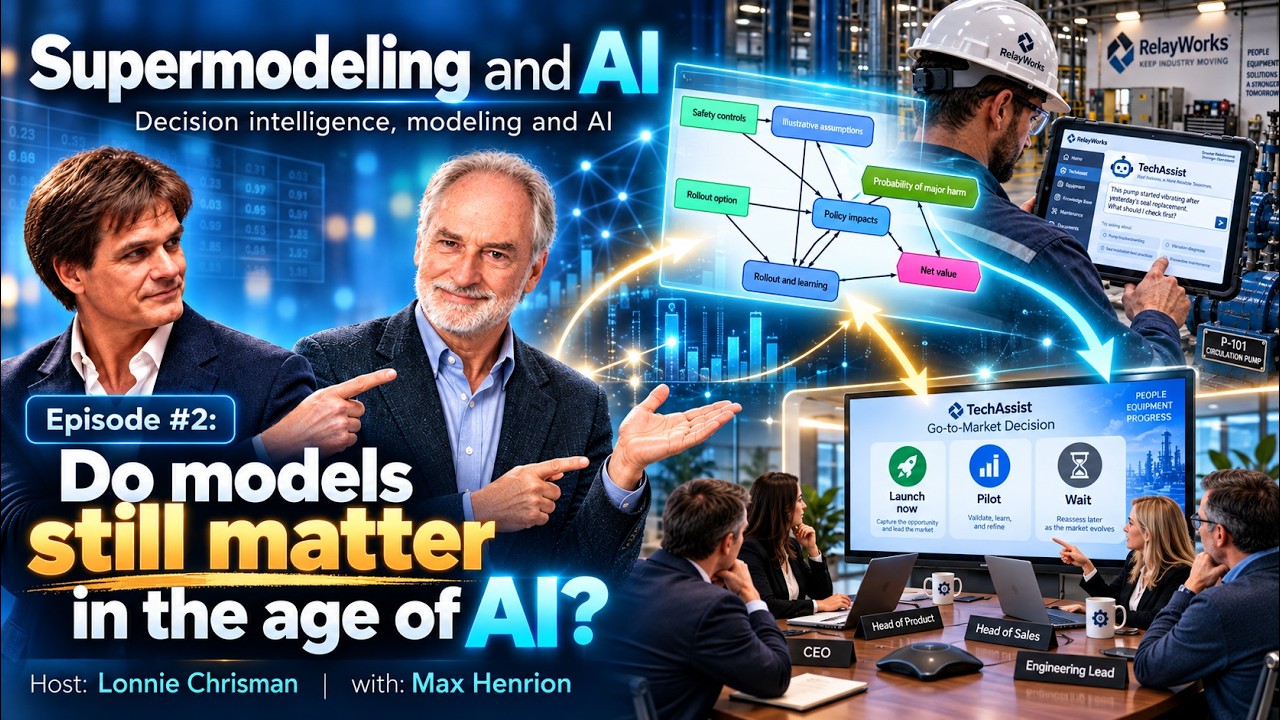
More from the series: watch all episodes of Supermodeling and AI, or go back to Episode 2: Do Models Still Matter in the Age of AI?
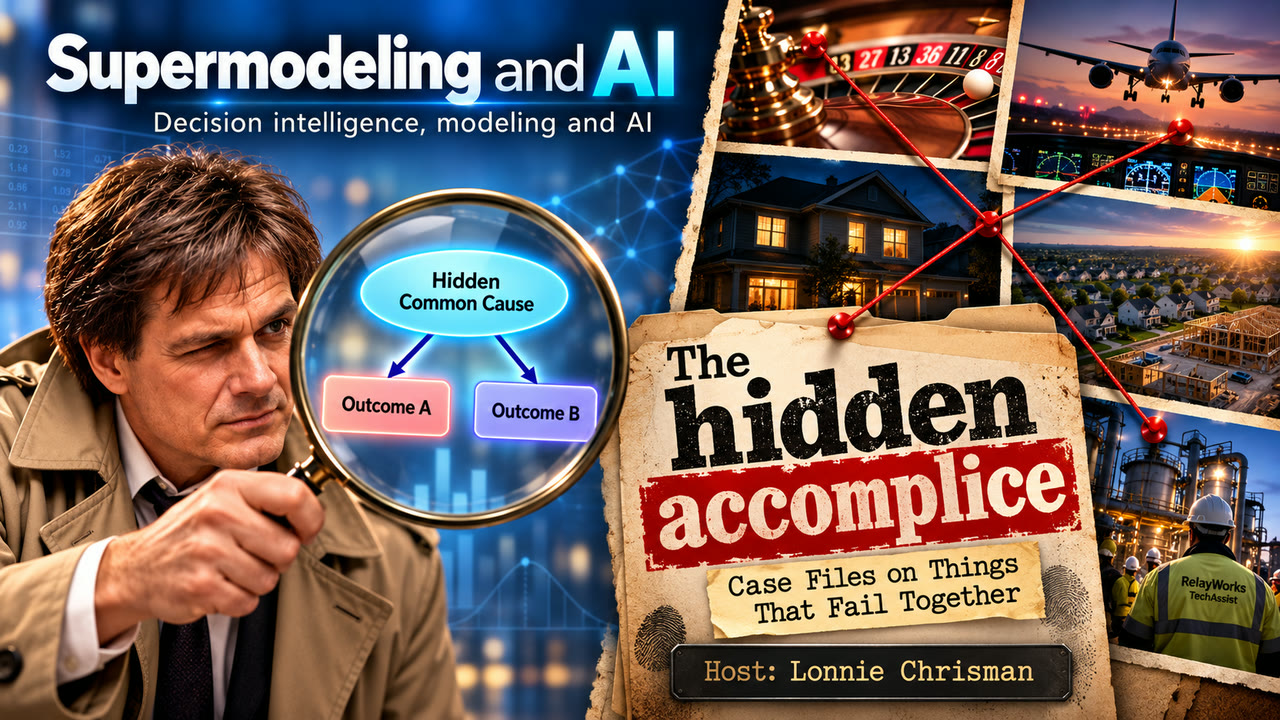
Next episode: Episode 4: The Hidden Accomplice Lonnie plays detective with uncertainties that aren’t alone: when one thing going wrong makes another more likely.